It's been years. Years upon years since I last sang.
Time takes a toll on the voice, and for so long, I was actually afraid to sing. Afraid that I'd go back to my "diva" attitude which was actually completely unintentional from the start.
But one day at Mass, the choir was so beautiful and I was so taken up into prayer by that beauty that I knew it was finally time to sing again. As if it were a direct message from God, that day at the end of Mass there was an announcement that they were looking for choir members. My heart rose and crashed at the same time; I am not available, ever, for their regular practice time. I couldn't join the choir.
In hope, though, I approached the Music Director, introduced myself and explained that I wanted to sing, used to cantor long, long ago, and that I couldn't join the choir. Might she have a place for me?
Just then a friend of mine passed by and we greeted each other. She agreed immediately (never having ever heard me sing) that I could Cantor with her. I urged the MD to "audition" me, insisting I might not be good enough. I know full well I don't have the range I used to possess and I, like everyone else, loathe bad cantors who don't know when to step down.
In our culture of entitlement and "self-esteem", far too many people are doing things they simply don't have the gifts to actually carry out.
My first rehearsal with my friend went well and our voices blended well together. That weekend as we sang together, it was beautiful, if not perfect (on my part). The sound guy approached us afterwards and said he couldn't tell us apart, and expressed that he hoped we'd often sing together for that Mass.
It was a good start, and I was happy.
Tonight I sang again. But this week's rehearsal in preparation didn't go well and I know well my voice is not up to par. Not yet. For all I know, maybe not ever. But the Music Director didn't seem concerned, and I remained grateful to be able to sing with someone else; a friend who is much better than I am! I knew that I could back off if I couldn't hit the note. She could.
Unfortunately, we weren't able to rehearse together this week, so I let her take all the solo parts. Even though I practiced them, and in fact, because I practiced them, I realized I simply couldn't do it. She was gracious and offered me these solos, but I turned them down in good conscience, out of a desire that the liturgy be beautiful.
Back in High School when I cantored, I admit I reveled in being a soloist. I loved it! Especially considering that I hadn't learned until Jr. High sometime that I actually had a good voice. To put it to use was amazing! And to receive accolades, however informal, was more amazing still!
All of us grow up, though, and having been away from the Church, and from singing for a very long time, I now come back with a different attitude.
First, I don't have the voice I had then, so there is cause for very conscious humility. (And that is NOT an oxymoron!). Secondly, I now know quite well what the Mass is about and Whom is to be honored, and it ain't me! Thirdly....it's a privilege to be able to sing, to Cantor the Mass. To truly pray, in song, the Mass in leading the other worshippers in those prayers.
I've learned that time takes a toll on the voice, but it tempers the soul, and as imperfect as I am, it is good to know that perhaps I still have something to offer. Maybe it's not that pretty right now, and maybe it never will be. But it's something, it's adequate and thank God that He is giving me the chance once again to sing for Him.
Thank you, Jesus.
Showing posts with label Liturgy. Show all posts
Showing posts with label Liturgy. Show all posts
Saturday, April 13, 2013
Monday, April 09, 2012
The Looming Shadow of the Cross
I get it. I "get" that it's the Octave of Easter and we're all supposed to be joyful and happy and bubbling over with over-enthusiasm because Jesus Christ has RISEN! ALLELUIA!
Yes, I DO believe, and I KNOW, without a doubt, that God condescended to become one of us, suffered the ransom for our sin through punishment and a really torturous, horrible death, and was buried. I believe He descended into Hell to seek out our first parents, Adam and Eve, and all the others who had gone to Gehenna to await the Messaiah, and freed them.
Yes, I believe, but this year, I remain in the Passion. I celebrate liturgically, but personally, I'm not "feelin'" it and let me just say this: this is exactly why our Faith is not about emotion.
One of the reasons I am Catholic is also because I do not have to "feel" the liturgical season and be smiley and happy just because, for the 2011th time we've celebrated the Resurrection of Christ. I'm thrilled that others are happy and I am overjoyed interiorly about all the "HE IS RISEN!" accolades posted by my friends an acquaintances online. One of the cool things about being Catholic is that we know the Cross is always with us and just because we celebrate something liturgically, it is not a requirement to experience it emotionally. Life happens and it is the Cross that makes it meaningful. It is the Cross and Resurrection that define EVERYTHING.
So it is that we continue to suffer the Passion of the type God gives us even as we liturgically celebrate with the Christian world. We may be crushed by the weight of the Cross, but we always look to the Resurrection, for were it not for that, the weight upon us would be far too heavy to bear. And in that is a kind of joy that cannot be expressed through mere words or smiley-faces or platitudes.
Holy Thursday was beautiful but busy, and I attended my own parish, wishing I could remain for Adoration at the Altar of Repose, but no, immediately after I had to leave due to family obligations.
It had been proposed several weeks ago that we take our mother to a Latin Good Friday Liturgy. On Friday morning, therefore, I loaded the car and went on a long drive to my brother's home in hopes of attending with them. Thankfully we'd done our research and knew the available Latin liturgies and how long it would take to arrive.
When I arrived at my brother's home, he greeted me with grim news: Mom was not doing well. He didn't know what was going on, exactly, but explained the previous evening she'd gone to the ER because she felt her throat closing up. She was apparently diagnosed with an allergy of some sort because they gave her Benadryl. Someone drove her home and my brother's fiance' was going to pick her up and drive her to her car, then on to my brother's house in time to leave for Good Friday services.
Well, he was concerned, because Mom was confused on the phone, expressed she couldn't walk, and said she was driving anyway. I called her and she sounded fine, said she'd realized she hadn't eaten (she'd diabetic and cannot fast on our required days), so ate and was better. As she wasn't slurred, I hung up and didn't order her to pull over and wait for us as I'd originally intended to do.
She arrived some time later and clearly, was having trouble walking. My brother expressed that this was how she'd behaved just after her blood sugar crisis after her angiogram last summer - a crisis that had landed her in the hospital for 5 days. She insisted she hadn't eaten so we gave her food and made the decision to take her to the Liturgy. It was unspoken that we'd divert or call for help if her condition deteriorated in any way.
Unfortunately, we are like shell-shocked children: we are so accustomed to crisis and weirdness as a baseline that we are completely unable to assess when our own mother should have proper medical care. When crisis is the standard, it takes a great deal to make the decision to involve the hospital...yet again.
As it turned out, we had to nearly carry Mom into the church, give her time to rest in a back pew, find a bathroom for her, walk her there, have her nearly fall in a psychological panic, watch her walk normally when it was convenient for her, deal with her nearly falling over when there were witnesses. It wasn't a matter of just one thing, but a combination of medical and psychological. I refused to give in to "crisis mode" and became the firm caregiver. I'm sure I appeared quite heartless to people in that particular parish when my mother nearly fell and grabbed onto me. I held her up while stating over and over again, "You're fine." without emotion and without coddling.
It's like raising an attention-seeking toddler: give in to emotion and turn the incident into a full-blown temper tantrum.
We sat near the front of the church so Mom could see (and so we'd have a quick escape need be), and close proximity to the altar rail as we'd be approaching it twice.
Mom seemed to follow along decently, mostly listened. I knew this was the first Latin liturgy she'd heard for over 50 years. For my brother and his girlfriend it was a first. Unfortunately, the parish did not have decent guides (most people attending this liturgy were regulars and had Missals - I had forgotten and left mine home). So it was that we followed what we could, I gave what little guidance I could, and, well, worried about Mom the entire time. I think my brother and I exchanged more glances in that 2 hour liturgy than we ever had at any other point in our entire lives.
When it was time for the Veneration of the Cross, we stood to go, and Mom moved as if to let me by. I bent down to ask her if she wanted to venerate the Cross. She stared at me blankly. I had to repeat it a couple times while signaling my brother to wait. The line was already moving but that was fine...I was sure they would let us in but we didn't want anyone held up by our slowness.
Finally she understood, nodded, and my brother and I lifted her and, flanking her, walked her out of the pew and into the aisle. The people were kind and allowed us to enter. We proceeded forward slowly, which was no problem in this particular veneration. The person in front of our trio venerated and moved aside. My brother and I glanced at the woman in the other line, waiting but she stood back, nodding at us to proceed. We both nodded in thanks (I think?), and brought Mom forward to the Cross so that she could bend and kiss the feet of Christ. The altar servers actually assisted by lifting the Crucifix slightly for her. Then my brother, then, although my mother tried to turn, by my brother's gentle prompting, she waited so that I could move forward.
I don't ever recall seeing so much detail in blood and nail on the feet of Jesus as I kissed Him.
What was happening was not lost on me.
As we turned and hobbled back at a snails' pace, people lining up behind us, Mom announced she had to go to the bathroom again, so we took her on the long trek in that direction.
I noticed she walked normally between the stall and the sink to wash her hands but the second that was over, she returned to her "helpless" state, obligating my brother and I, once she was in the hallway, to bear her up again and constantly direct her to stop looking at her feet, but rather, look ahead. Yet every time another person approached, she'd panic and we'd be holding her up as one would a person drowning in the ocean.
At one point, Mom's panic aside, I smiled at some children on their way also to the bathroom, stepping aside so that they could proceed, indicating they should go. We were making a spectacle, holding up traffic everywhere, and not by necessity. Yet...all around us deferred to us, even though we were strangers among them. It was no matter: we were Catholic and therefore, we were family.
It was a repeat at Communion and the first time in 50 years Mom was able to kneel at the Communion rail to receive Our Lord. Because of her physical problems I advised her to stand but lean (and said she could lean on me as I knelt) since kneeling would be so hard for her. But no, she knelt and received. Our relatives came behind us not to receive as they could not, but to assist, and again, as we lifted her up and carried her back to her pew, the people of this very reverent, traditional parish waited and moved as they could to allow us to pass.
After it was over my brother got the car to pick her up and we took her home, ordering her to check her sugar, wondering if we should go to the ER or, by then, because she was improving, perhaps "wait and see".
Although we'd planned to attend the Vigil together, I went alone out of a personal obligation, and as Mom still had problems walking, she remained home. By the time I arrived back, Mom was in bed although she did join us around 1 am for some time, at which point we learned there was an "aftercare" document given to her by the ER. A document she hadn't shared with my brother and stated, last night, that she "couldn't understand no matter how many times she read it."
The document was clear: first, she should not have driven at all to my brother's home. (We knew that and had told her to stay home as she was not well.) All her symptoms required a return to the ER, but because we've gotten so used to both real and psychosomatic behavior as "normal" for her, we did not follow this. Had we had that document in hand, we would not have attended Good Friday, but would have spent that time in the ER instead.
Last night, my brother and I both confronted Mom on her need to give us the documents from her ER and other doctor visits, and reiterated to each other that we HAVE to talk to her doctor and perhaps get her into an Assisted Living facility that has greater supervision than the minimal facility she is in now (which has only pull cords).
It was not an easy conversation and I left it to take my dog out, where I took the time to take a deep breath and say a quick prayer of apology and request for help.
He is Risen!
Yes, He is Risen Indeed, but Mom is nearing the end of her days.
This is the part where people feel the need to quote platitudes about hope and the Cross and the Resurrection and such. And this is exactly why such platitudes are so offensive.
In the midst of the Cross, there is no such thing as comfort. The road to Calvary must be walked, it is awful for all involved. This is where we find fortitude, perseverance, and hope - through experience, not through trite sayings.
The Cross does not disappear just because we liturgically celebrate the Resurrection. Easter in the world does not end temporal suffering. It all continues.
What I say it this: it is the Cross that gives meaning to it all. It is not about emotion or candy or roasting lambs on a spit in the front yard with a red velvet lamb cake decorated with peeps for dessert.
It is ok to enter into suffering even in the most liturgically joyful Octave of our Calender. In fact, perhaps it is this suffering that reveals the Holiness the most, for it is for THIS that Christ suffered and died. THIS suffering, RIGHT NOW. For everyone, In all moments, the big and the little ones, ALL.
The Cross looms for all, for none of us will pass into Eternity without first passing through the Cross.
Yes, I DO believe, and I KNOW, without a doubt, that God condescended to become one of us, suffered the ransom for our sin through punishment and a really torturous, horrible death, and was buried. I believe He descended into Hell to seek out our first parents, Adam and Eve, and all the others who had gone to Gehenna to await the Messaiah, and freed them.
Yes, I believe, but this year, I remain in the Passion. I celebrate liturgically, but personally, I'm not "feelin'" it and let me just say this: this is exactly why our Faith is not about emotion.
One of the reasons I am Catholic is also because I do not have to "feel" the liturgical season and be smiley and happy just because, for the 2011th time we've celebrated the Resurrection of Christ. I'm thrilled that others are happy and I am overjoyed interiorly about all the "HE IS RISEN!" accolades posted by my friends an acquaintances online. One of the cool things about being Catholic is that we know the Cross is always with us and just because we celebrate something liturgically, it is not a requirement to experience it emotionally. Life happens and it is the Cross that makes it meaningful. It is the Cross and Resurrection that define EVERYTHING.
So it is that we continue to suffer the Passion of the type God gives us even as we liturgically celebrate with the Christian world. We may be crushed by the weight of the Cross, but we always look to the Resurrection, for were it not for that, the weight upon us would be far too heavy to bear. And in that is a kind of joy that cannot be expressed through mere words or smiley-faces or platitudes.
Triduum
Holy Thursday was beautiful but busy, and I attended my own parish, wishing I could remain for Adoration at the Altar of Repose, but no, immediately after I had to leave due to family obligations.
It had been proposed several weeks ago that we take our mother to a Latin Good Friday Liturgy. On Friday morning, therefore, I loaded the car and went on a long drive to my brother's home in hopes of attending with them. Thankfully we'd done our research and knew the available Latin liturgies and how long it would take to arrive.
That's when the Cross came to us.
When I arrived at my brother's home, he greeted me with grim news: Mom was not doing well. He didn't know what was going on, exactly, but explained the previous evening she'd gone to the ER because she felt her throat closing up. She was apparently diagnosed with an allergy of some sort because they gave her Benadryl. Someone drove her home and my brother's fiance' was going to pick her up and drive her to her car, then on to my brother's house in time to leave for Good Friday services.
Well, he was concerned, because Mom was confused on the phone, expressed she couldn't walk, and said she was driving anyway. I called her and she sounded fine, said she'd realized she hadn't eaten (she'd diabetic and cannot fast on our required days), so ate and was better. As she wasn't slurred, I hung up and didn't order her to pull over and wait for us as I'd originally intended to do.
She arrived some time later and clearly, was having trouble walking. My brother expressed that this was how she'd behaved just after her blood sugar crisis after her angiogram last summer - a crisis that had landed her in the hospital for 5 days. She insisted she hadn't eaten so we gave her food and made the decision to take her to the Liturgy. It was unspoken that we'd divert or call for help if her condition deteriorated in any way.
Unfortunately, we are like shell-shocked children: we are so accustomed to crisis and weirdness as a baseline that we are completely unable to assess when our own mother should have proper medical care. When crisis is the standard, it takes a great deal to make the decision to involve the hospital...yet again.
As it turned out, we had to nearly carry Mom into the church, give her time to rest in a back pew, find a bathroom for her, walk her there, have her nearly fall in a psychological panic, watch her walk normally when it was convenient for her, deal with her nearly falling over when there were witnesses. It wasn't a matter of just one thing, but a combination of medical and psychological. I refused to give in to "crisis mode" and became the firm caregiver. I'm sure I appeared quite heartless to people in that particular parish when my mother nearly fell and grabbed onto me. I held her up while stating over and over again, "You're fine." without emotion and without coddling.
It's like raising an attention-seeking toddler: give in to emotion and turn the incident into a full-blown temper tantrum.
We sat near the front of the church so Mom could see (and so we'd have a quick escape need be), and close proximity to the altar rail as we'd be approaching it twice.
Mom seemed to follow along decently, mostly listened. I knew this was the first Latin liturgy she'd heard for over 50 years. For my brother and his girlfriend it was a first. Unfortunately, the parish did not have decent guides (most people attending this liturgy were regulars and had Missals - I had forgotten and left mine home). So it was that we followed what we could, I gave what little guidance I could, and, well, worried about Mom the entire time. I think my brother and I exchanged more glances in that 2 hour liturgy than we ever had at any other point in our entire lives.
When it was time for the Veneration of the Cross, we stood to go, and Mom moved as if to let me by. I bent down to ask her if she wanted to venerate the Cross. She stared at me blankly. I had to repeat it a couple times while signaling my brother to wait. The line was already moving but that was fine...I was sure they would let us in but we didn't want anyone held up by our slowness.
Finally she understood, nodded, and my brother and I lifted her and, flanking her, walked her out of the pew and into the aisle. The people were kind and allowed us to enter. We proceeded forward slowly, which was no problem in this particular veneration. The person in front of our trio venerated and moved aside. My brother and I glanced at the woman in the other line, waiting but she stood back, nodding at us to proceed. We both nodded in thanks (I think?), and brought Mom forward to the Cross so that she could bend and kiss the feet of Christ. The altar servers actually assisted by lifting the Crucifix slightly for her. Then my brother, then, although my mother tried to turn, by my brother's gentle prompting, she waited so that I could move forward.
I don't ever recall seeing so much detail in blood and nail on the feet of Jesus as I kissed Him.
What was happening was not lost on me.
As we turned and hobbled back at a snails' pace, people lining up behind us, Mom announced she had to go to the bathroom again, so we took her on the long trek in that direction.
I noticed she walked normally between the stall and the sink to wash her hands but the second that was over, she returned to her "helpless" state, obligating my brother and I, once she was in the hallway, to bear her up again and constantly direct her to stop looking at her feet, but rather, look ahead. Yet every time another person approached, she'd panic and we'd be holding her up as one would a person drowning in the ocean.
At one point, Mom's panic aside, I smiled at some children on their way also to the bathroom, stepping aside so that they could proceed, indicating they should go. We were making a spectacle, holding up traffic everywhere, and not by necessity. Yet...all around us deferred to us, even though we were strangers among them. It was no matter: we were Catholic and therefore, we were family.
It was a repeat at Communion and the first time in 50 years Mom was able to kneel at the Communion rail to receive Our Lord. Because of her physical problems I advised her to stand but lean (and said she could lean on me as I knelt) since kneeling would be so hard for her. But no, she knelt and received. Our relatives came behind us not to receive as they could not, but to assist, and again, as we lifted her up and carried her back to her pew, the people of this very reverent, traditional parish waited and moved as they could to allow us to pass.
After it was over my brother got the car to pick her up and we took her home, ordering her to check her sugar, wondering if we should go to the ER or, by then, because she was improving, perhaps "wait and see".
Holy Saturday
Although we'd planned to attend the Vigil together, I went alone out of a personal obligation, and as Mom still had problems walking, she remained home. By the time I arrived back, Mom was in bed although she did join us around 1 am for some time, at which point we learned there was an "aftercare" document given to her by the ER. A document she hadn't shared with my brother and stated, last night, that she "couldn't understand no matter how many times she read it."
The document was clear: first, she should not have driven at all to my brother's home. (We knew that and had told her to stay home as she was not well.) All her symptoms required a return to the ER, but because we've gotten so used to both real and psychosomatic behavior as "normal" for her, we did not follow this. Had we had that document in hand, we would not have attended Good Friday, but would have spent that time in the ER instead.
Last night, my brother and I both confronted Mom on her need to give us the documents from her ER and other doctor visits, and reiterated to each other that we HAVE to talk to her doctor and perhaps get her into an Assisted Living facility that has greater supervision than the minimal facility she is in now (which has only pull cords).
It was not an easy conversation and I left it to take my dog out, where I took the time to take a deep breath and say a quick prayer of apology and request for help.
Easter Sunday
He is Risen!
Yes, He is Risen Indeed, but Mom is nearing the end of her days.
This is the part where people feel the need to quote platitudes about hope and the Cross and the Resurrection and such. And this is exactly why such platitudes are so offensive.
In the midst of the Cross, there is no such thing as comfort. The road to Calvary must be walked, it is awful for all involved. This is where we find fortitude, perseverance, and hope - through experience, not through trite sayings.
The Cross does not disappear just because we liturgically celebrate the Resurrection. Easter in the world does not end temporal suffering. It all continues.
What I say it this: it is the Cross that gives meaning to it all. It is not about emotion or candy or roasting lambs on a spit in the front yard with a red velvet lamb cake decorated with peeps for dessert.
It is ok to enter into suffering even in the most liturgically joyful Octave of our Calender. In fact, perhaps it is this suffering that reveals the Holiness the most, for it is for THIS that Christ suffered and died. THIS suffering, RIGHT NOW. For everyone, In all moments, the big and the little ones, ALL.
The Cross looms for all, for none of us will pass into Eternity without first passing through the Cross.
Saturday, March 10, 2012
God Breathes - Man Receives - and Reciprocates
It occurs to me upon watching August Rush for the umpteenth time (I'm a slow learner), that the pipe organ scene that makes me cry EVERY TIME I watch it has a deeper meaning.
I connect it of course to the Mass, for as a teen I was a cantor mostly accompanied by the Pipe Organ, always wondering why my Mom was head-over-heels for it. In my life it seemed merely consequential. In fact, at the time, I hated cantoring for the Organ and preferred piano for its unwavering 5th grade simplicity. It didn't challenge me, ergo I could sing with it, without ever being challenged beyond the level of elementary music.
Now, as I hear the gloriousness of the Pipe Organ through August Rush, even though my own parish has the premier Pipe Organ in the entire Archdiocese, I so rarely hear it. Every time I do, via film or in real life, I am brought to my knees, and when is my own parish, and I hear it during the Sacred Liturgy, I am not just brought to my knees, but to tears for it so brings me to God as it is designed.
You see, the Pipe Organ hearkens back to Genesis...it gives back to God what He gave to Man (to US as humanity for the theologically-challenged among us).
God gave us (Man) life by breathing into Adam and therefore, all his progeny (US!).
The Pipe Organ is man expelling that breath back to God in holiness, a response of thanksgiving, supplication, praise, and sacrifice in ultimate worship.
That is what the Pipe Organ represents and why, as described in Sacrosanctum Concilium, the Vatican II document on the Mass, holds it in such high and necessary regard.
When such a noble instrument falls silent we lose our liturgical life and the worship due unto God in its complete fullness.
Explains a lot about our sad liturgical times, doesn't it?
I connect it of course to the Mass, for as a teen I was a cantor mostly accompanied by the Pipe Organ, always wondering why my Mom was head-over-heels for it. In my life it seemed merely consequential. In fact, at the time, I hated cantoring for the Organ and preferred piano for its unwavering 5th grade simplicity. It didn't challenge me, ergo I could sing with it, without ever being challenged beyond the level of elementary music.
Now, as I hear the gloriousness of the Pipe Organ through August Rush, even though my own parish has the premier Pipe Organ in the entire Archdiocese, I so rarely hear it. Every time I do, via film or in real life, I am brought to my knees, and when is my own parish, and I hear it during the Sacred Liturgy, I am not just brought to my knees, but to tears for it so brings me to God as it is designed.
You see, the Pipe Organ hearkens back to Genesis...it gives back to God what He gave to Man (to US as humanity for the theologically-challenged among us).
God gave us (Man) life by breathing into Adam and therefore, all his progeny (US!).
The Pipe Organ is man expelling that breath back to God in holiness, a response of thanksgiving, supplication, praise, and sacrifice in ultimate worship.
Take a deep breath. Now expel it with all your force, knowing others are doing so the same time as you during Mass - all over the world, in every time and every century, including now and eternity beyond us all.
That is what the Pipe Organ represents and why, as described in Sacrosanctum Concilium, the Vatican II document on the Mass, holds it in such high and necessary regard.
When such a noble instrument falls silent we lose our liturgical life and the worship due unto God in its complete fullness.
Explains a lot about our sad liturgical times, doesn't it?
Saturday, July 02, 2011
The Word Can Speak for Himself: Stop Being So Dramatic!
Point 1: Lectors vs Readers
I am a huge proponent of using proper terms in the proper settings. The word "Lector" is one of them. Canonically (ie referring to Canon Law), there is no such thing as a "Lector" in our parishes, and no, Vatican II did not do away with this appointed position. The reality is this: only men can be appointed Lectors, although the 1983 Code of Canon Law allows uninstalled men and women both to READ during the liturgy, and for both, it is a privilege. Still, only MEN can be appointed, and so I find it both insulting and irritating that we continue to call READERS "Lectors" as this misuse and overuse of terminology denigrates the Office of Lector itself, and leaves us to wonder if the Readers at Mass are in fact installed Lectors or are just filling the role because the Bishop refuses to install the proper men or because not enough have stepped up to the plate.
I suspect it's more a lack of education on the part of all lay people. I had to pay thousands of dollars and get a Master's degree to obtain this simple information that should be readily available and explained to the general populace of any given parish. It's not like Canon Law is a secret.
Lest someone protest, indeed, as a Minor Order it was suppressed, but the new Code did NOT suppress the installation of the position or the obligation upon those installed to serve in that capacity during the Liturgy. Ergo, if an installed Lector is in attendance at a given Mass, there should not be an uninstalled Reader performing the liturgical role.
Point II: Dramatic Readings of the Lectionary
It has become the fashion at my parish for the readings to be read dramatically, according to the whims of the canonically not-installed Readers, both male and female, although I cringe to admit the problem seems to have been introduced by a woman.Still...the virus seems to affect men, too.
Nearly every time I have attended Mass at my parish within the last year or so, I have had to look around to see if, in fact, I was present at a "Concert" given by an Elocutionist as portrayed in "Anne of Green Gables."
To be clear; I am not saying the readings should be proclaimed in a monotone! That is just as awful! Rather, I am merely suggesting that those doing the Readings for the Mass each week follow the description given in the GIRM, paragraph 56:
"The Liturgy if the Word is to be celebrated in such a way as to promote meditation, and so any sort of haste that hinders recollection must clearly be avoided."
Yes, indeed. However, pausing dramatically after every few words and over-emphasizing every third word a la melodrama does not meet the theological understanding of "meditation". It falls to "dramatic interpretation" and is TERRIBLY distracting!
So as not to be uncharitable, I quote the continuing context of the GIRM, paragraph 56:
"During the Liturgy of the Word, it is also appropriate to include brief periods of silence, accommodated to the gathered assembly, in which, at the prompting of the Holy Spirit, the word of God may be grasped by the heart and a response through prayer may be prepared. It may be appropriate to observe such periods of silence, for example, before the Liturgy of the Word itself begins, after the first and second reading, and lastly at the conclusion of the homily."
This puts the first part in context. I suspect that the more dramatic Readers tend to read the first part of this paragraph (assuming they have actually read this very important document) and stop there, thinking that their idea of "meditation" and "silence" is the proper one. Therefore, we in the pews are afflicted by their own PERSONAL reading versus their reading of the Word for the rest of us, who are trying to meditate upon it.
Appreciation for a Role Carried out Appropriately
One of the things I most loved about my various monastery and convent visits was this: they all understood meditative reading in accordance with the General Instruction of the Roman Missal. Not a single Sister got up and read according to her own interpretation. Certainly her voice rose and fell for general emphasis, but it was always carried out to foster our OWN meditation, so that we could allow the Holy Spirit to emphasize words and phrases...not the reader.
Every time a Dramatic Reader takes the pulpit in my parish, I consider fleeing. The first time it happened, the woman actually looked at the
Since that time, this behavior has become all the rage of our parish
I'd say I'm sorry, but I'm not. We in the pews have a right to speak up, too, and it's not proper to throw tomatoes at Mass or cut the cords to the sound system. That kind of thing is generally frowned upon. Unfortunately, it has become the culture in our parishes that those who speak up, even gently, are cranks, and no real criticism is tolerated, for fear it might hurt someone's feelings.
God forbid someone in a liturgical role is introduced to the GIRM and therefore has their feelings offended by official documentation.
The Readings at Mass are not meant to be read as though proclaimed in a theatre, but are meant to be proclaimed in a worshipful setting, open to be received by the people in the pews, all ranges of people. There is a place for drama, but the Word of God doesn't need any help from we lay people; He can stand alone just fine on His own if the Readers would only stand aside enough to let Him speak.
I long for the monastery, and the sober, truly meditative reading of the Word of God, in the Office, in the Lectionary, and pray that one day, our lay Readers will also cultivate an appreciation for this lost, yet simple, art of proclaiming the Word to the Faithful devoid of their own personal dramatic interpretation.
Saturday, March 19, 2011
St. Joseph and the Liturgy
 I've long had a deep devotion to St. Joseph, but I've never considered him in the context of Sacred Liturgy. Reginaldus at The New Theological Movement has posted a brilliant reflection on St. Joseph as a model for priests, especially with regard to the Mass.
The following is an excerpt from the post which struck me as especially astute (emphasis mine):
The need for manly devotion in the celebration of the Sacred Liturgy
The feminization of the Holy Mass is a serious problem in the modern Church. It is not that the Liturgy must be utterly masculine, especially if this be understood in such a way as to exclude women from participating (remembering, of course, that the truest and most active participation is spiritual and internal). Nevertheless, there is a growing recognition of the fact that the sanctuary is becoming a place where men (and boys) are losing their manhood and becoming more like women – this may then have the odd counter-effect of making some women act like men, but that is a problem for another article.
What are some indications of this feminization of the Liturgy and, together with it, of the men (and boys) who serve at the Sacred Rites? Consider, for instance, the hyper-relational emphasis of the modern Liturgy (rather, of the Liturgy as it is often celebrated in modern times). The focus is all too often turned from sacrifice to salutation, from worship to welcome. Obviously, greeting and welcome have their proper place in the Liturgy, but adoration and sacrifice must not be ignored. This movement from offering adoration through sacrifice to greeting and welcome is certainly an indication of a movement from a masculine to a feminine perspective – not that all men want to offer sacrifice, nor that all women want to build community; but these are certainly underlying drives in each gender, respectively. Nor do we say that one is bad and the other good – it only need be emphasized that the male priest (and the altar boys) are very often pressured to deny the masculine sacrificial focus in order to accentuate a more feminine form of community-building. Indications of this would be the use of modern hymns and modern musical instruments, increased “commentary” and ad lib speaking, the placement of the altar closer to the nave, and (above all else) facing the people throughout the Liturgy.
I couldn't agree more! Please go on and read the rest so as to get the full context.
This section was especially striking to me because I've touched on this topic before and of course with my own growing understanding of sacred liturgy, it is one of the modern problems that absolutely makes me crazy when it comes up at deanery meetings and the like. All too often, it seems like the (generally female) laity "in charge" of various parishes are in favor of stripping beauty, making us "more like other faith traditions" and push female "participation" in various liturgical roles.
Sadly, instead of highlighting the proper gifts of women, it seems to turn well-meaning and faithful women in to puppets for those with an agenda of power and the result, which we witness every day, is the "feminization" Reginaldus describes.
The reality is that the Mass NEVER needed to be "feminized".
Certainly some abuses needed to be curtailed and some development needed to occur, as it has, organically throughout the centuries, but the average person never foresaw the destruction and the "wrath of woman" that has done so much damage to our sanctuaries, our architecture, our patrimony...and therefore our sacred liturgy.
The Church as Bride

The Liturgy is, quite literally, the face of the Church. When we speak to non-Catholics, they know us by the Mass we attend every Sunday, and maybe every day. I've known many people who have attended Catholic weddings, funerals, and that was their only real contact with Catholicism. When they look at a Catholic, they are less likely to see our beliefs, but recall vividly our liturgy.
(Never mind there shouldn't be that kind of disconnect - but there it is.)
The Church is already feminine - deeply, deeply feminine. The Church as a whole is the Bride of Christ, and Holy Communion, the consummation of that Holy and Eternal Marriage. In the Mass, the Bridegroom offers Himself as an immolation for His Bride, and the Bride approaches, open to receive Him and offer fully of herself in sacred union.
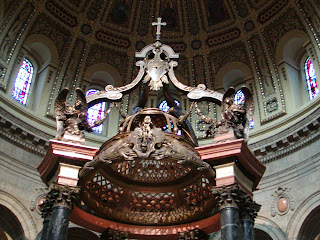
This is why many Cathedrals and other churches built in the traditional style have a canopy (Baldacchino) over the high altar; it represents this spousal relationship between God and His people.
Look around you in a beautiful parish: there is stained glass full of symbolism pointing to the purity of the Saints, the sacrifices they made, colors representing universal understanding of things like martyrdom, betrayal, royalty, purity, chivalry...the list goes on. The light of the sun falling through the glass is an adornment upon the Bride, reflected through the jewels created by human hands for the Glory of God. The statues of Mary, Jesus and the Saints are breathtaking, often adorned with floral arrangements, and established within a parish to give proper significance to them in relation to the people, the parish, and the Church as a whole. These things point to eternity and speak volumes of the sensuality and intuitiveness proper to the nature of women.
The clothing worn by the priests and altar servers are made often by women - nuns who have given their lives to their Lord -Brides in the individual sense, with Him, laying their lives down in sacrifice proper to a spouse. The chausables from any time in history therefore have a woman's touch, a sense of beauty that both pleases the eye and guides one to meditate upon eternity.
Consider the architecture of a great Cathedral or beautiful Church, and compare it to the beauty of a woman, perhaps as described in the Song of Songs. People of many faiths, and none at all, visit Catholic Cathedrals, Basilicas, and Churches as tourists, in awe of the magnificence. One cannot help, when entering these buildings, but to recognize the feminine nature of our ancient decor.

And then contrast it with the more "feminized" buildings, vestments, and "art" of the modern culture - and wonder if someone drank too much kool-aid and decided to take up the hobby of the destruction of beauty.
The Masculinity of the Priesthood
As Reginaldus discusses, St. Joseph is the epitome of masculine worship. He is a protector, he knows about sacrifice, suffering, and in all that, was a compliment to his spouse and a father to Our Lord.
The nature of the priesthood is both one of service and sacrifice. There is a hard practicality to that sacred Vocation which is informed by the feminine nature of the Church as a whole, yet reinforced with a solid foundation so as to stand as a bulwark against the winds that try to buffet her about.
The Church needs BOTH of these natures, the masculine and feminine, in order to bear fruit, and do so abundantly.
The disorder we've been both witness to and suffered from in the last 50 years or so has confused the nature of the liturgy and has caused great divisions among the faithful. I truly believe that this is one of the reasons John Paul II wrote the Theology of the Body, and that this series of Wednesday Audiences was the harbringer of Pope Benedict XVI's liturgical reforms.
I have no solutions to offer, but post this only as an observation. I don't speak for any particular faction within the Church, but only as a faithful Catholic woman who has found freedom in the privilege of being a woman through understanding the true nature of the Church and her relationship to her head, the Bridegroom, Jesus Christ.

St. Joseph...pray for us!
Sunday, November 21, 2010
I Am the Dog, Baby
I was going to write about something else tonight, but instead, I have a rant. Sit down and hold on to your hats.
A few years ago, a reporter wrote an article in the Religion section of the local paper and by the wording, made it sound like a decision of our Bishop was "personal" (note the spelling). There was a HUGE outcry in the blogging world as everyone slammed the Bishop for making a "personal" decision with regard to a certain popular priest.
I went to the article itself, found the phone and email of the religion reporter and CALLED her to ask about the quote generating so much bandwidth. Was it "personal" or "personnel"? Which? The spelling made a huge difference.
She returned my call and explained it was an editorial error: it wasn't a "personal" decision of the Bishop, but a "personnel" decision belonging to employer/employee, and that meant all the bloggers having hissy fits were hanging out with egg on their respective faces.
I think I actually made that phone call and got the answer while in the presence of actual bloggers, but it was so long ago I can't remember. I'm getting old. Memory is second to go, they say.
Refusal to Reason
I've noticed a pattern, and I've been a part of it myself.
We go to Mass, at this or that parish, and not always our home parish. Whether it is "home" or some other, with the ability to speak to our "online friends" through Social Networking, we often bring our complaints. This alone is legitimate. We often experience liturgical abuses and need to vent, ask questions to see if what we noticed is legit or an abuse, or maybe we have nowhere else to go to explain our frustration with the lack of reverence we may witness in a given Mass. It is legitimate to vent those frustrations, as long as we don't let those frustrations, or worse, anger, control us. We should be asking for help not to further our vice of anger, but rather, to help us overcome our vices, to affirm what is wrong and help us to do or react in ways that give glory to God.
All too often, all I see, or all I do is "vent", slam, and yes, even calumniate.
All too often, when others do so, when questioned, they tend to either back down or refuse to go to the source.
My friends, this is not reasonable. It is, officially a sin, for it is contrary to the intellect and will, and therefore, it is an offense against God.
We really need to examine our own consciences regarding our intentions when we use social networking. Even tonight a friend of mine brought to issue a reasonable question for which that person refused to seek the truth.
The incident called me to look into my own online affairs and question how many times I have sought "answers" while refusing to ask the questions of those who so offended us all. It really is so much easier to go to others of our own mind than directly ask the questions of those we think are offending.
It really is easier to run away like Judas than confront offense as directly as Christ.
Canon Law follows this procedure, requiring that the person (usually a priest or bishop) allegedly offending is first confronted before the person making the complaint goes to the Bishop or other proper authority. There is great reason in this: it is to prevent the sin of defamation of character, to keep from someone being slandered in the eyes of others. The procedure itself, via scripture or via Canon Law (which is one and the same in this case) is to ensure the examination of conscience and purity of heart in the one making the accusation.
Online Danger of Calumny/ Detraction
Too often, online, we tend to vent our frustrations without actually seeking a response and without actually wanting to go to the work of confronting an offense.
As a parish worker, I relate to this on two levels: as a blogger and as a parish worker who sees offense but doesn't have any official capacity to correct it.
It IS very frustrating, but more and more, I am becoming aware of the damage done by those with a voice who either don't know or won't follow the charitable procedure of confronting the offender directly.
Too often, names and situations are smeared through Facebook, Twitter, Plurk, and Blogs, without the person speaking ever to bother to go directly to the one being "confronted" to address them directly.
All too often, those using Social Networking (again, I am guilty, too) fall back on our own laziness so as to bitch and complain without any real intention of correcting a problem.
Recently a friend, one both online and in real life brought up an issue in a parish she attended. She asked a good question, and one that needs to be asked and addressed according to the theology of the Church. The question asked is one that could be charitably sent to the "offender" and perhaps answered. This friend refused to do so and made every argument not to, even refused to let me send the (charitable!) email or note, and then told me that I "didn't have a dog in this fight."
If there' s a battle involving the liturgy that is Universal, if there's a battle involving the Theology of the Church, e.g. the Truth of Christ, I AM the Dog, Baby.

Telling me that I don't have a dog in this fight means that you're telling me I'm not Catholic.
Are we not the Mystical Body of Christ? If one of us suffers, do the others remain immune? If you experience a horrible liturgy at one place and refuse to tell anyone, do I suffer more or less than you do if I attend there after you have passed by and refused to do nothing about it, saying that I "don't have a dog in this fight."?
Doesn't that happen every day and aren't we all sick of the smell?
Listen, ya'll, whether we know each other personally or not, we're all together in this mess. If we are Catholic, we are members of the Mystical Body and if there is a public offense against theology and liturgy, it hurts us all and we have a duty, obligation, and right to question it.
Don't EVER tell another Catholic that they "Don't have a dog in the fight" or that their concerns regarding an objective theological/ liturgical matter are insignificant.
To do so is an insult to the entire Body of Christ.
Y'all, you ARE the Dog, and if you're not in the fight, Christ is not your King.
Amen.
A few years ago, a reporter wrote an article in the Religion section of the local paper and by the wording, made it sound like a decision of our Bishop was "personal" (note the spelling). There was a HUGE outcry in the blogging world as everyone slammed the Bishop for making a "personal" decision with regard to a certain popular priest.
I went to the article itself, found the phone and email of the religion reporter and CALLED her to ask about the quote generating so much bandwidth. Was it "personal" or "personnel"? Which? The spelling made a huge difference.
She returned my call and explained it was an editorial error: it wasn't a "personal" decision of the Bishop, but a "personnel" decision belonging to employer/employee, and that meant all the bloggers having hissy fits were hanging out with egg on their respective faces.
I think I actually made that phone call and got the answer while in the presence of actual bloggers, but it was so long ago I can't remember. I'm getting old. Memory is second to go, they say.
Refusal to Reason
I've noticed a pattern, and I've been a part of it myself.
We go to Mass, at this or that parish, and not always our home parish. Whether it is "home" or some other, with the ability to speak to our "online friends" through Social Networking, we often bring our complaints. This alone is legitimate. We often experience liturgical abuses and need to vent, ask questions to see if what we noticed is legit or an abuse, or maybe we have nowhere else to go to explain our frustration with the lack of reverence we may witness in a given Mass. It is legitimate to vent those frustrations, as long as we don't let those frustrations, or worse, anger, control us. We should be asking for help not to further our vice of anger, but rather, to help us overcome our vices, to affirm what is wrong and help us to do or react in ways that give glory to God.
All too often, all I see, or all I do is "vent", slam, and yes, even calumniate.
All too often, when others do so, when questioned, they tend to either back down or refuse to go to the source.
My friends, this is not reasonable. It is, officially a sin, for it is contrary to the intellect and will, and therefore, it is an offense against God.
We really need to examine our own consciences regarding our intentions when we use social networking. Even tonight a friend of mine brought to issue a reasonable question for which that person refused to seek the truth.
The incident called me to look into my own online affairs and question how many times I have sought "answers" while refusing to ask the questions of those who so offended us all. It really is so much easier to go to others of our own mind than directly ask the questions of those we think are offending.
It really is easier to run away like Judas than confront offense as directly as Christ.
Matthew 18:15-17:
If your brother sins against you, go and tell him his fault, between you and him alone. If he listens to you, you have gained your brother. But if he does not listen, take one or two others along with you, that every word may be confirmed by the evidence of two or three witnesses. If he refused to listen to them, tell it to the church; and if he refuses to listen even to the church, let him to be you as a Gentile and a tax collector.
Canon Law follows this procedure, requiring that the person (usually a priest or bishop) allegedly offending is first confronted before the person making the complaint goes to the Bishop or other proper authority. There is great reason in this: it is to prevent the sin of defamation of character, to keep from someone being slandered in the eyes of others. The procedure itself, via scripture or via Canon Law (which is one and the same in this case) is to ensure the examination of conscience and purity of heart in the one making the accusation.
Online Danger of Calumny/ Detraction
Too often, online, we tend to vent our frustrations without actually seeking a response and without actually wanting to go to the work of confronting an offense.
As a parish worker, I relate to this on two levels: as a blogger and as a parish worker who sees offense but doesn't have any official capacity to correct it.
It IS very frustrating, but more and more, I am becoming aware of the damage done by those with a voice who either don't know or won't follow the charitable procedure of confronting the offender directly.
Too often, names and situations are smeared through Facebook, Twitter, Plurk, and Blogs, without the person speaking ever to bother to go directly to the one being "confronted" to address them directly.
All too often, those using Social Networking (again, I am guilty, too) fall back on our own laziness so as to bitch and complain without any real intention of correcting a problem.
Recently a friend, one both online and in real life brought up an issue in a parish she attended. She asked a good question, and one that needs to be asked and addressed according to the theology of the Church. The question asked is one that could be charitably sent to the "offender" and perhaps answered. This friend refused to do so and made every argument not to, even refused to let me send the (charitable!) email or note, and then told me that I "didn't have a dog in this fight."
What "fight"?
If there' s a battle involving the liturgy that is Universal, if there's a battle involving the Theology of the Church, e.g. the Truth of Christ, I AM the Dog, Baby.
SO ARE YOU!

Telling me that I don't have a dog in this fight means that you're telling me I'm not Catholic.
Are we not the Mystical Body of Christ? If one of us suffers, do the others remain immune? If you experience a horrible liturgy at one place and refuse to tell anyone, do I suffer more or less than you do if I attend there after you have passed by and refused to do nothing about it, saying that I "don't have a dog in this fight."?
If a heretic farts in the wind, aren't we ALL downwind?
Doesn't that happen every day and aren't we all sick of the smell?
Listen, ya'll, whether we know each other personally or not, we're all together in this mess. If we are Catholic, we are members of the Mystical Body and if there is a public offense against theology and liturgy, it hurts us all and we have a duty, obligation, and right to question it.
Don't EVER tell another Catholic that they "Don't have a dog in the fight" or that their concerns regarding an objective theological/ liturgical matter are insignificant.
To do so is an insult to the entire Body of Christ.
Y'all, you ARE the Dog, and if you're not in the fight, Christ is not your King.
Amen.
Saturday, June 12, 2010
Graduation
One week ago today, I graduated with my Master's degree.


I arrived at the Church thinking that it would be as anti-climactic as that day, 15 years ago, when I mounted the stage to accept my Bachelor of Arts degree. This was, of course different as our class was significantly smaller, "we'd" [meaning a few people on the graduation committee who worked their tails off, God bless them!] had to plan the event "ourselves" (with guidance from the University), and, as I was to find out...the Mass and Ceremony were a LOT more intense than I'd expected. And a lot more solemn.
We processed into the Church to the awesome tones of Gregorian Chant. The Schola Choir was beautiful, and, as the organist we'd hired did not show up for some unexplained reason, the purity of the voices rising in praise to God were unsullied, reminding us not just of the dignity of the occasion, but of the eternal holiness of the Mass.
"The Church Needs You!"
I couldn't stop looking at the Crucifix during the Bishop's homily, as he spoke of God's call to us all to serve His Church, his exhortation to serve with a deep love for sinners, and to go out to evangelize. "As one Apostle to another...." I looked at the Bishop, startled. His homily sounded more like a COMMISSION than anything else, and of course that was no mistake. God had called us to study. We had responded, and now it was time to go out into the world, bringing to souls all that we had learned....and in so doing, bring them back Home. "The Church needs you!" the Bishop reiterated again and again throughout his homily.
I knew it was no mistake, but all in God's timing, that we had attended our last class on the (transferred) Feast of the Ascension. That alone pointed to the great commission of Our Lord to the Apostles, to go forth and baptize all nations. It was no mistake, but all in God's Providence that we graduated on a First Saturday, a day traditionally set aside to especially honor the Immaculate Heart of Mary, and it was no mistake that we were there just before the close of the Year for Priests, in the Month of the Sacred Heart.
There, well within the Heart of the Church, the Bishop emphasized our responsibility. Oddly enough, I was taken back to the day I was sworn in as a Police Officer. The weight of my Oath, the badge, the gun, and later, the vest, symbolized the weight of my responsibility for lives. As a Police Officer, if I screwed up, lives would be lost. I realized that what the Bishop was saying pointed to something far greater, something that called me to the foot of the Cross, to lay the burden there too heavy for me to carry: as a theologian, if I screw up....souls will be lost. Not just lives, but....souls!
Interiorly, I shuddered, then clung to the bloodied wood upon which my Savior hung. I still don't know exactly what He is calling me to do, but there is no doubt; if I have come this far, it is God's intent that I spend myself in union with Christ for the salvation of souls.
Commencement
We processed out at the end of the Mass, and I couldn't help but notice all the flashbulbs going off as we passed. It was from that point on that I began to commence with the squirming. I don't like having my picture taken; I never have, but on that day, there was no way to escape it. I had to quite literally grin and bear it.
We processed in, yet again, this time for the actual Commencement ceremony. The Commencement Address was given by one of our beloved professors, and he gave what we recognize as his final lecture ("No extra charge!" cracked the Program Director later on.), and while we knew it would go over the heads of many of the attendees, we understood it perfectly and appreciated all he had to say. Our Class Speaker had something to say about (and therefore, to) each and every one of us about "...what we learned in our 75 half hour and 10 minute breaks over the last 3 years...", and I gotta say, he nailed each and every one of us, bringing many of us to tears. (I actually managed to rein myself in...if I got going, I knew I wouldn't be able to stop!). I admit that as I write this now, I'm tearing up a bit, thinking about all my fellow students and friends, all we have gone through since we have begun, both the greatest of tragedies and some incredible triumphs.
We received the blessing of the Bishop and processed out, this time with the flash-bulb popping ever closer to us, even as we exited the hall. We gathered in a group for a large group photo with the present Professors and the Bishop. I'm pretty sure all of us were squirming from all the attention. After all, we're bookworms, not celebrities!
As the photo session seemed to go on endlessly, still holding what was probably by that point a clay grin, through our smiling teeth some of us asked, "Are we done yet? Can we go now?" And still the cameras continued to point in click.
One of my classmates commented, "This must be what celebrities feel like!"
Someone else queried, "Are we celebrities?"
And yet another cracked, "Hey! They're paparazzi! We have our own paparazzi!" Which, of course, caused many of us to burst into laughter, turning our "Danceline smiles" into real ones once again.
It was a little while before I finally made it into the Hall again to find my fans friends and family. We'd all been limited in the numbers of people we could invite, and suddenly I was grateful for that, for I quickly realized that I didn't have time to be "hostess" to them all. I'm not a socialite by nature, but realized I did have to find a way to greet all of my guests, even while saying goodbye to my classmates, some of whom I am quite certain I will never see again this side of the veil.

Finally, finally I had the opportunity to open the the leather-bound, gold-embossed degree the Bishop had handed me. I stared at it a moment, noting it was all in Latin. "Oh my gosh, I have a Master's Degree and I can't even READ it!"
It's good to have a reminder to remain humble, that although we have learned a great deal, we've only scratched the surface. It is an invitation to be grateful, and yet, to go deeper, to continue seeking the Truth.
Our Graduation was a bittersweet event, almost painful in its intensity. I do have a sense of accomplishment, though, of having completed something I set out to do, finally. I know it is a gateway to something, a simple stone on the path I am following to Calvary, and now my foot hovers in mid-air as I try to see the next step.
* * *
Monday, May 24, 2010
Consummation
Yesterday, Pentecost, I attended a Low Mass in the Extraordinary Form.
Sacred Heart had a beautiful high altar, but no communion rail and so prie-dieux were set up in rows at the foot of the sanctuary, leaving a space in the center as one would find had a communion rail been present. The attendance was very low, just a few families and individuals scattered throughout; the kind of crowd certain media bastions love to photograph.But oh, was the Spirit alive there, and bearing fruit with virility...

This Pentecost Mass was a Low Mass; no music, but the prayers usually inaudible during a Missa Cantata or a Solemn High Mass were audible to us which made it easier to follow along. (Not that I did a good job at doing so.)
Still, it was perfect for Pentecost, for the silences were deeper without the ostentatious professional choir that inhabits a local Baroque parish, a different kind of beauty in full compliment to the raucous noise found in other places. God does not come as a storm or an earthquake, but in that still small voice, if only we could stop shouting into the wind long enough to finally listen.
I relished the simplicity of the silences, the rhythm of the Latin prayers, the genuflections, and the chance to "offer up" the pain in my bad knees from their constant contact with long-petrified kneelers.
When it was time to go forward for Holy Communion, I recalled, as I always do, that we are proceeding to the foot of the Cross so that we may take the flesh of God into ourselves; the very Sacred Heart of our beloved Savior. I remind myself that we are being fed from the Tree of Life; given the fruit of the Cross, the author of eternal Salvation.
The anticipation grows, almost becoming an anxiety that there "won't be enough". I want that kind of desperation for the Sacrament; the constant draw, the hope, the anticipation that leads to that raw edge; almost a fear of loss.
I know that because I have that intense interior longing at times, that the Most Holy Sacrament of the Altar indeed has value, more than anything else on earth. (I have not yet become too jaded to recognize Whom I am receiving.) When I have those moments of intensity, I hold on to them as tightly as I can, retaining them in my memory for it seems that daily, the dryness of the spiritual life encroaches even further.
This time, instead of kneeling at the rail, I knelt at the prie-dieu and waited, listening to the priest offer, "Corpus Christi" as he blessed each Communicant with the Sign of the Cross, holding Christ between his finger and thumb. I listened as he came closer, the anticipation building.
Kneeling there wasn't the same as the Communion rail, and I could not stop the lament that rose from within; the opportunity to kneel at the same marble as the altar so as to receive from the same altar of Sacrifice itself. I was all too aware of the spiritual poverty of our age, and yet, joyful, for here was a priest who could read the signs of the times and provide the spiritual sense of the rail, if not the reality. And in the Mass, the most important symbols transcend their reality to lead us into the deeper reality of the Paschal Mystery; eternal union with God Himself.
I knew, therefore, that it didn't matter that this makeshift "rail" wasn't actually of the identical material of the altar; the spiritual meaning far transcended what was under my knees.
Father and the altar server were nearing; now I could see peripherally the Sign of the Cross being made with the host at the intonation of "Corpus Christi".
As I continued to fix my gaze upon my Crucified Lord, I suddenly realized I could not recall whether or not to say "Amen" in response. I thought back to the different forms of the Mass at which I've assisted; the Ordinary Form in the vernacular (Amen!), the Ordinary Form in Latin (Amen!), the Ruthenian Rite of the Byzantine Church (non), and the Extraordinary Form of the Roman Liturgy (?????). I couldn't remember.
I tried to listen but I was so absorbed in Christ for the moment that the responses (or lack thereof) were lost to me.
My white lace head-covering caught my peripheral attention as, subconsciously I sought to see how soon I'd be receiving Our Lord. The veil itself (usually I wear black) was reminiscent especially on Pentecost, of a Bride's veil, of her purity. I recalled my First Communion veil, not really understanding that even then, I was a Bride of Christ and that all First Communicants are representative of the entire Church, past, present and future. First Communion Masses often feel like weddings because they ARE...and so is every Mass!
I was lost in time, but not a bit anxious about that fact. I wanted to kneel there forever, even if it meant waiting, even if Father eternally came close, but never brought Our Lord to me. It was sufficient to me to know that He was there; Holy Communion begins long before the actual moment of reception.
The voices and movements were closer and my heart pounded, thirsting for what was being offered to me. It is always this way at the communion rail; there is always this elongated moment of anticipation, this time to gaze upon the Cross, to absorb the Sacrifice made on our behalf, the Sacrifice calling or our own conscious and willing union, our own specific consent to the self-sacrifice required of every Catholic. Even in a few seconds, we experience this extended lifetime of intimacy, drawing us deeply into the fiery intensity sweetly burning Jesus into our souls, one heartbeat at a time.
Finally Father and the altar server stood before me. I heard him intone, "Corpus Christi", and he made the Sign of the Cross over me, holding Christ in his hand as he spoke, the movement in perfect synchronicity with the Latin words announcing that finally, Jesus had come to me in all of His hidden Glory.
Father and the server left us in privacy as the next of the Mystical Body took their places at the foot of the Cross.
I crossed myself and stood, regretting having to go so quickly, but taking My Beloved Lord with me to the pew, kneeling there in silence, delighting in my Savior, thanking him with a quiet certainty far from superficial emotionalism. When tears arose, they caressed my eyes as briefly as a lover's kiss, falling upon the interior so as not to spoil the gentle afterglow.
Sacred Heart had a beautiful high altar, but no communion rail and so prie-dieux were set up in rows at the foot of the sanctuary, leaving a space in the center as one would find had a communion rail been present. The attendance was very low, just a few families and individuals scattered throughout; the kind of crowd certain media bastions love to photograph.But oh, was the Spirit alive there, and bearing fruit with virility...

Come, Holy Spirit....
This Pentecost Mass was a Low Mass; no music, but the prayers usually inaudible during a Missa Cantata or a Solemn High Mass were audible to us which made it easier to follow along. (Not that I did a good job at doing so.)
Still, it was perfect for Pentecost, for the silences were deeper without the ostentatious professional choir that inhabits a local Baroque parish, a different kind of beauty in full compliment to the raucous noise found in other places. God does not come as a storm or an earthquake, but in that still small voice, if only we could stop shouting into the wind long enough to finally listen.
I relished the simplicity of the silences, the rhythm of the Latin prayers, the genuflections, and the chance to "offer up" the pain in my bad knees from their constant contact with long-petrified kneelers.
When it was time to go forward for Holy Communion, I recalled, as I always do, that we are proceeding to the foot of the Cross so that we may take the flesh of God into ourselves; the very Sacred Heart of our beloved Savior. I remind myself that we are being fed from the Tree of Life; given the fruit of the Cross, the author of eternal Salvation.
The anticipation grows, almost becoming an anxiety that there "won't be enough". I want that kind of desperation for the Sacrament; the constant draw, the hope, the anticipation that leads to that raw edge; almost a fear of loss.
I know that because I have that intense interior longing at times, that the Most Holy Sacrament of the Altar indeed has value, more than anything else on earth. (I have not yet become too jaded to recognize Whom I am receiving.) When I have those moments of intensity, I hold on to them as tightly as I can, retaining them in my memory for it seems that daily, the dryness of the spiritual life encroaches even further.
This time, instead of kneeling at the rail, I knelt at the prie-dieu and waited, listening to the priest offer, "Corpus Christi" as he blessed each Communicant with the Sign of the Cross, holding Christ between his finger and thumb. I listened as he came closer, the anticipation building.
As I always do, I gazed from the alter to the Crucifix, visually taking in Love Incarnate, nailed to the Cross...for me.
Kneeling there wasn't the same as the Communion rail, and I could not stop the lament that rose from within; the opportunity to kneel at the same marble as the altar so as to receive from the same altar of Sacrifice itself. I was all too aware of the spiritual poverty of our age, and yet, joyful, for here was a priest who could read the signs of the times and provide the spiritual sense of the rail, if not the reality. And in the Mass, the most important symbols transcend their reality to lead us into the deeper reality of the Paschal Mystery; eternal union with God Himself.
I knew, therefore, that it didn't matter that this makeshift "rail" wasn't actually of the identical material of the altar; the spiritual meaning far transcended what was under my knees.
Father and the altar server were nearing; now I could see peripherally the Sign of the Cross being made with the host at the intonation of "Corpus Christi".
As I continued to fix my gaze upon my Crucified Lord, I suddenly realized I could not recall whether or not to say "Amen" in response. I thought back to the different forms of the Mass at which I've assisted; the Ordinary Form in the vernacular (Amen!), the Ordinary Form in Latin (Amen!), the Ruthenian Rite of the Byzantine Church (non), and the Extraordinary Form of the Roman Liturgy (?????). I couldn't remember.
I tried to listen but I was so absorbed in Christ for the moment that the responses (or lack thereof) were lost to me.
My white lace head-covering caught my peripheral attention as, subconsciously I sought to see how soon I'd be receiving Our Lord. The veil itself (usually I wear black) was reminiscent especially on Pentecost, of a Bride's veil, of her purity. I recalled my First Communion veil, not really understanding that even then, I was a Bride of Christ and that all First Communicants are representative of the entire Church, past, present and future. First Communion Masses often feel like weddings because they ARE...and so is every Mass!
I was lost in time, but not a bit anxious about that fact. I wanted to kneel there forever, even if it meant waiting, even if Father eternally came close, but never brought Our Lord to me. It was sufficient to me to know that He was there; Holy Communion begins long before the actual moment of reception.
The voices and movements were closer and my heart pounded, thirsting for what was being offered to me. It is always this way at the communion rail; there is always this elongated moment of anticipation, this time to gaze upon the Cross, to absorb the Sacrifice made on our behalf, the Sacrifice calling or our own conscious and willing union, our own specific consent to the self-sacrifice required of every Catholic. Even in a few seconds, we experience this extended lifetime of intimacy, drawing us deeply into the fiery intensity sweetly burning Jesus into our souls, one heartbeat at a time.
As always, I was nearly trembling.

Finally Father and the altar server stood before me. I heard him intone, "Corpus Christi", and he made the Sign of the Cross over me, holding Christ in his hand as he spoke, the movement in perfect synchronicity with the Latin words announcing that finally, Jesus had come to me in all of His hidden Glory.
I opened to receive Him, giving of myself so that we might become one in this eternal moment of consummation, praying that this union would bear fruit not just in this world, but through eternity.
Father and the server left us in privacy as the next of the Mystical Body took their places at the foot of the Cross.
I crossed myself and stood, regretting having to go so quickly, but taking My Beloved Lord with me to the pew, kneeling there in silence, delighting in my Savior, thanking him with a quiet certainty far from superficial emotionalism. When tears arose, they caressed my eyes as briefly as a lover's kiss, falling upon the interior so as not to spoil the gentle afterglow.
* * *
2 O that you would kiss me with the kisses of your mouth! For your love is better than wine,
3 your anointing oils are fragrant, your name is is poured out; therefore the maidens love you.
4 Draw me after you, let us make haste. The king has brought me into his chambers.
We will exult and rejoice in you; we will extol your love more than wine; rightly do they love you.
~ The Song of Solomon 1:2-4
Come, Holy Spirit...
Sunday, March 07, 2010
Byzantine Divine Liturgy - Ruthenian Rite

This visit to the Byzantine Church was the first for all of us, and we knew some very basic differences and that the Divine Liturgy (their term for the Mass) is quite different than what one would find in a Roman Catholic Church, although it is the same thing; the re-presentation of the Holy Sacrifice of Calvary.
For those who may not know, the Eastern Churches make the Sign of the Cross from right to left, as opposed to the Roman version which is left to right. As today, the 3rd Sunday of the Great Fast, they celebrate the Sunday of the Holy Cross, there is an explanation in their bulletin for the very reason for this tradition:
"Blessing oneself with two fingers brought to the thumb represents the Trinity. The last two fingers held to the palm represent the two natures of Jesus - God and man. For the first 1,200 years of the Church, in making the Sign of the Cross, the hand was typically brought from the right to the left shoulder even in the Western Church. In the East this is still the practice, to signify Christ enthroned at the right hand of the Father. According to tradition and in the words of Pope Innocent II (1198-1216), the Sign of the Cross is made with three fingers because it is impressed upon us in the name of the Holy Trinity. From the forehead we pass to the breast, then from the right to the left."
I admit I did not know this as the reason for the difference and I will have to look into why the tradition changed in the Western Church (that's us, Roman Catholics!). I surmise there must be a theological reason for our tradition of left to right, or we wouldn't be doing it. Does anyone know?
 We arrived early, and upon entering the Church was empty. I took the opportunity to take a couple photos of the very small church, which was built in the Western style, but inside, was clearly Eastern in worship. The Iconostasis was striking, as was the scent of incense that permeated our senses. We knew immediately that we were in for a real treat! Nothing says "Heaven touches earth" than the smell of incense!
All of us are familiar with both expressions of the Roman Rite: the Ordinary Form (often pejoratively called the "Novus Ordo") and the Extraordinary Form (often pejoratively called the "Pre-Vatican II Mass"). Of course, what this means is that we all immediately were attracted by the holy scent of incense which does amazing things to prepare one, all by itself, for the Holy Sacrifice of the Mass, or, in Byzantine Terms...the Sacred Mysteries.
When a few people arrived, we went out into the entry area with the children as their footsteps and toddler commentaries echoed throughout the space, and we wanted to be respectful of those who desired to pray and might better do so in silence. After all, as guests in a new place, we wanted to be polite! Besides, not knowing the character of the Church, it is always best to stand back an observe as opposed to insinuating oneself into a situation!

As it was, we became the impromptu "welcoming committee" for the regular parishioners, most of whom seemed thrilled to run the short gauntlet of young families and children. Several people commented on the dear children and how welcome was their presence. Even though I am not called to marriage and have no children, I have to admit it warmed my own heart to hear and see such expressions of love and welcoming for them.
Still, though, I have to admit; I now have a new appreciation for Protestants and other non-Catholics who visit a Catholic Mass for the first time, knowing only the most rudimentary things. I think I had the same misgivings and really, wanted to be sure not to offend. I was quite comfortable with the idea that we would stand out as visitors (well, not exactly "comfortable"...more....acquiescent to the terms of being a visitor to something new) and even more so when we saw the small size of the church itself. While when I first attended my own parish I could "hide", but here, it was impossible for any of us to simply "blend in." We all knew it up front and just went with the flow.
A wonderful thing happened, though, as we waited for the Divine Liturgy to begin: an old friend of mine from college walked up the steps and into the Church. I haven't seen him in years, but he looks just like he did back then. (I swear..some people NEVER age!). On the other hand, I've changed quite a bit (I got fat like the rest of my Irish farmer family), but simply didn't have it in me to pretend I didn't know my old friend. Initially he didn't recognize me but all was well, he introduced us to his daughter and spent some time talking with us, helped us with some common things, emphasized that at Communion we should not stick our tongues out as Roman Catholics are wont to do, and, we found, he himself had prepared the leavened bread to be consecrated at that Mass! (Yes, this is proper in the Byzantine Church and it's not something EVERYONE does.)
Initial Observations:
When people entered the church, they did not genuflect as we do in the Roman Church. It appeared that they reverenced (kissed) the icons upon entry, some wrote something in a book (forgot to ask about that), and bowed before entering their pew. Instead of kneeling to pray in preparation as we do, they stood for a time, then sat. This is of course quite alien to the Roman but given our surroundings, did not seem "out of place".
The parishioners were very helpful and directed us to the books and guides that would help us follow along, and I found that, in fact, the Liturgy was very easy to follow as it was in English. While (I think) there were a few songs and prayers in Slavic, overall most was in the vernacular with all the traditional chants.
 Divine Liturgy
There are no musical instruments in a Byzantine Liturgy. As some explanations for this go, all come as they are, with what they have, and who they are. Instrumentation is not necessary, for God gave us voices to raise to Him in praise and supplication; nothing else glorifies God so much as that which He Himself created.
The melodies were very easy to follow, and believe me, there is a LOT of singing in the Byzantine Rites! But in those places where the choir sang, and although I am familiar with Byzantine Chant, it is an entirely different thing to hear that chant in the proper setting of the Liturgy.
Oh! I know now how angels sound when they sing their eternal praises to God!
I'm sorry, but very little of the music I have EVER heard in the Roman Catholic Church can compare to the simple chants of the Byzantine Liturgy.(click the link to go to a Byzantine site where you can hear the chants and order the CD.) And I put their music far over and above what we hear even in the holy ostentatiousness of the Baroque choirs of Mozart and his ilk at the infamous St. Agnes. (Which I admit, quite un-popularly, to be quite loud and too ostentatious at times. Sorry to those who love it, and yes, I do think it is far better than the Broadway faire of Haugen-Haas)
For those who have never experienced an Eastern Liturgy of any type, it is quite different. There are some similar elements, but it takes a LOOONG time to get to those things we recognize, such as the readings (which differ from ours) and the Consecration, which DOESN'T have bells to call our attention to it. Incidentally, there ARE bells in the first half of the Divine Liturgy, although I forgot to inquire as to the significance.
In following along, though, what impressed me was the ongoing praise to God alternated with the cries for His mercy, which is what the Liturgy throughout the Church, properly done is all about: knowledge and praise of God, while coming to know oneself in the face of God. So much of this is lost in the Roman Liturgy, not because of the liturgy itself, but through the music which, in the Roman Mass, tends to be more of a celebration of ourselves as opposed to great praise and supplication to God. (This is the point of reform within the Roman Catholic Church, and for good reason!)
There was absolutely no doubt, in this Liturgy, to WHOM it was addressed, and WHY. Yet, for those who want to juxtapose the interior with the exterior practices of our Faith would find them quite united here. I think that those who love to focus on the physical participation in the Mass in the Roman Catholic Church would find their home here in the Byzantine, for there are few pauses and it is dominated by the active singing and response of the congregation. In fact, I know someone who has a very difficult time focusing unless she is doing something at Mass, and may really find that the Byzantine Divine Liturgy keeps her attention as it demands a constant response.
I have to wonder if the minds behind Sacrosanctum Concilium were looking at the Eastern Liturgies as they wrote that document, seeking to combine the focus that has always oriented the Liturgy in all Rites to God with both the interior participation as well as the "active" participation of the Faithful.
The Doors and the Icons
While the Byzantine Church also has an Offertory (for which I was not prepared today, to my shame), it is followed by the Liturgy of the Eucharist, which again, differs greatly but was still helpful in orienting me as to what was going on at the time. The book containing the Liturgy of St. John Chrysostom was very helpful, but still, I found that I needed to be focused on what was happening in the sanctuary through the opened Doors, to which our attention is called throughout.
 To explain, briefly, the Iconostasis, which operates much like a Communion Rail in a Roman Catholic Church (in those few where it remains), separates the human world from the heavenly world. It contains 3 doors: in the center are the Holy (or Royal) Doors, which open to the Sanctuary where the Blessed Sacrament is reserved, and represent the Gates of Heaven. Only the Priest may pass through these particular doors; any others are automatically excommunicated for the infringement. The Deacon's Door, to the right, is graced by the image of St. Stephen (at least at St. John the Baptist), the protomartyr behind which we see the Deacon's Altar. The door to the congregation's left is the Server's door, and portrays most often, and clearly in this particular Byzantine Church, the icon of St. Michael the Archangel.
Of note in every Byzantine Church, you will find on one of the doors to your right, the icon of St. Nicholas of Myra, the Patron of the Byzantine Church.
Holy Communion
I admit I was nervous to receive Communion in the Byzantine Church, if only because it is a little different. I am accustomed to receive on the tongue, so opening my mouth to receive Our Lord isn't the problem. Rather, because this is such a Holy Moment, a Holy Action, I wanted to be certain that if I screw up at any point, it wouldn't be THAT point! I even seriously considered not receiving at all!
Yet I knew I could...I went to Confession yesterday, am sure I had not committed any mortal since since my Confession, and really, the newness shouldn't detain me. Yet..that's just me. I'm a wimp and often want to hang back instead of trying new things, especially when making a mistake with new things can become sacrilege.
I had asked my friend, in the entryway about this, and this is where he emphasized to receive by tilting the head back, mouth open. For all the Roman Catholics out there....do NOT stick out your tongue! He laughed about how they always know a Roman by the instruction, "Tongue in!" and according to habit, we stick our tongues OUT to receive!
Not in the Eastern Church. I actually LOVED Holy Communion in this form, so I will explain it from a newbie perspective in anticipation of other newbies:
You will queue up like we always do. Like the English, we Roman Catholics in America are very serious about our queues, so you can expect here what you do at Communion time at Mass.
There is a small table (Tetrapod) near the front containing an icon (Pictured) with two candles on either side. Today, as we venerated the Holy Cross, the Tetrapod contained an icon of the Crucifix. At Holy Communion, consistent with the spirituality of each person coming to God as they are, each person went forward to the Priest to receive. We formed two lines, waited at the Tetrapod. and when the person before us had moved aside, went forward.
I noticed that the server beckoned me...I don't know if he does that for each person or just for newbies. It could be that I waited too long to advance.
The servers on either side of the Priest hold up a red cloth (I know there is a name for this, please inform me) beneath the chin of the one receiving. Many people bent their knees, and although I am short, I did a little, too, to make it easier for the Priest. Make a sign of reverence while standing in line (much like the Roman Rite), then approach, the Priest will offer Christ from a chalice where the leavened bread that has become the Body of Christ is mingled with the Precious Blood in the Chalice that he holds. If needed, bend your knees, open your mouth (tongue in!), and the Priest will use a spoon to place the Sacrament in your mouth.
I have read this too, and know this is hard to envision. But I can tell you this: today I KNEW I had received God Himself, the very BLOOD AND FLESH of Christ on my tongue. I can't describe it, but it is completely different from the physical "feeling" of Holy Communion in a Roman Catholic Church. I have received by valid intinction (consecrated hosts on a paten with a small chalice attached, where the Priest intincts the Host) in a Roman Catholic Church, but this was still a bit different.
I have a strong devotion to the Precious Blood of Christ, but don't often receive from the chalice, and found that Holy Communion today has brought me more deeply into that particular devotion in a way I will not soon forget.
After Holy Communion, the Faithful return to their pews and stand, for in the Eastern Church, THAT is the sign of reverence. I knew this in advance and thought that I would miss kneeling, and indeed, I WANTED to kneel. This Church had kneelers utilized by some, but I found that I wanted to remain standing given the practice and the ancient sign of respect in this Church. After all...when in Byzantine, do as the Byzantines do.

I did not have that sense of discomfort today. That speaks volumes.
Dismissal
During Holy Communion there are several Hymns, and following, prayers of Thanksgiving. There are more prayers to be merciful to we, the sinner, supplications to God, and an admonition from the Priest to be attentive to Our Lord and the Holy Spirit, as I recall. (I'm sorry I can't link to this part of the Liturgy)
There was no procession out to which we Romans are accustomed.
The people in front of us took this time to introduce themselves and welcome us to their church, invited us back, exclaimed over the children, and said that they had been raised as Roman Catholics. Lovely people, and for some reason, reminded me of Texans. I don't know why and can't explain this. (no accent, they just..quirkily, made me think of Texans).
But because they were so homey and personable,and seemed so informal even though something was STILL going on in the Church, I was a bit discomfited. I was watching the Faithful filing forward, as if for Holy Communion, instead of filing out.Clearly people were receiving a blessing from the Priest, who was holding a glass bowl containing what appeared to be oil.
To either side stood servers, the one to my left holding the Bulletin, the one to the right holding a basket and a bulletin.
The man I asked explained that because it was the Sunday to venerate the Holy Cross, they were going forward for the veneration of the Icon of the Cross, and then to the Priest for a blessing. He explained that the basket contained the bread that was not used in Communion.
I went forward, kissed the Cross, and found that the person in front of me was engaged in a conversation with the priest. I'd started to move forward but saw that I should wait as their conversation continued...clearly this was more informal. It reminded me of the Roman Rite of the Liturgy of the Priest Greeting after Mass.
 The Priest used what looked like a fine-tipped paint brush to paint a cross on my forehead with the holy oil from the bowl. I had to hold back my bangs for this, as did other women. He spoke in Slavic, so I have no idea what he said.
 I did not take any of the bread from the basket, but one of my friends asked the Server if it was the Eucharist. He said that it was.
No, it wasn't. It was blessed bread, but as I understand, not consecrated, so not Christ Himself. This was a cause for concern for a time, but my friend explained it to us (thankfully!) and I can assure anyone who experiences this that no one is desecrating the Eucharist!
After this, we received a tour of the Church, I took photos of the icons while listening, and find that I will need to attend again both with more knowledge of the Ruthenian Divine Liturgy, and to get better photos of the icons.
I left feeling blessed, knowing that I had received Our Lord, and with a greater appreciation of the Universal Church.
Thank you, Jesus.
***Update: Reminder regarding the commenting policy: Please assign a name to yourself. "Anonymous" comments will be deleted. *****


Wednesday, February 17, 2010
Lord Who Threw Out These 40 Days?
This post was originally published in March of 2008, and yes, it's Ash Wednesday so I figured now is as good a time as any to re-post it. Sing along and enjoy!

********
I wasn't going to do this, especially because it's Holy Week and we should all be solemn and sad and preparing our hearts for the Passion of Christ. And I won't in a thousand years suggest that you NOT do this. However, Fr. V. over at Adam's Ale has been a very bad influence on me and has triggered me to write one of my rare song parodies. He supplied the first two lines.
Q: Lord, who threw out these 40 days?
A: No one, they’re still here!
Q: But I thought Vatican II
Tossed all that we held dear!
Q: Father, the liturgist you hired
Put sand and rocks in fonts
And said that sacramentals
Are things that V2 lost.
She said that all the laity
Are all the priests we need!
She said that dancing in the aisles
Is required in the Creed!
Your Worship Director’s worse!
He covered up the Cross…
With a big ol' screen to praise the words
Of Haugen and Haas!
The travesties that we behold
Too much…I have a list!
Because I’ve read the Council’s words
And think that they’ve been dissed!
Can we restore these 40 days
And gaze upon the Cross?
We need to have a Triduum
To know that we’re so lost!
Where is the penitential rite?
Has that been sent away?
Can we be forgiven
Or is our church astray?
How can we know that Jesus died
For our souls to save
If we can’t see the crucifix
And sin has been denied.
Father restore these 40 days
To prepare us for these three:
We need the Holy Triduum
For our great salvation to see!
(NOTE: THIS IS VERY ROUGH AND SUBJECT TO CHANGE/ADDITIONS)

********
I wasn't going to do this, especially because it's Holy Week and we should all be solemn and sad and preparing our hearts for the Passion of Christ. And I won't in a thousand years suggest that you NOT do this. However, Fr. V. over at Adam's Ale has been a very bad influence on me and has triggered me to write one of my rare song parodies. He supplied the first two lines.
Q: Lord, who threw out these 40 days?
A: No one, they’re still here!
Q: But I thought Vatican II
Tossed all that we held dear!
Q: Father, the liturgist you hired
Put sand and rocks in fonts
And said that sacramentals
Are things that V2 lost.
She said that all the laity
Are all the priests we need!
She said that dancing in the aisles
Is required in the Creed!
Your Worship Director’s worse!
He covered up the Cross…
With a big ol' screen to praise the words
Of Haugen and Haas!
The travesties that we behold
Too much…I have a list!
Because I’ve read the Council’s words
And think that they’ve been dissed!
Can we restore these 40 days
And gaze upon the Cross?
We need to have a Triduum
To know that we’re so lost!
Where is the penitential rite?
Has that been sent away?
Can we be forgiven
Or is our church astray?
How can we know that Jesus died
For our souls to save
If we can’t see the crucifix
And sin has been denied.
Father restore these 40 days
To prepare us for these three:
We need the Holy Triduum
For our great salvation to see!
(NOTE: THIS IS VERY ROUGH AND SUBJECT TO CHANGE/ADDITIONS)
Sunday, December 20, 2009
Transcendent
This weekend, I decided that since I had time, I would drive down to attend the Mass in the Extraordinary Form (EF), going by myself for the very first time. The first time I assisted at this form of the Mass was just over one year ago, the First Sunday of Advent, the first one in 40 years at the Church of St. Agnes in St. Paul.
Although I was fairly familiar with their Latin Ordinary Form (OF), I found the EF to be quite different, but even MORE transcendent.
Although the little clipper that came through last night made driving a bit treacherous, I decided that it was worth it, and so I took my rosary in hand and drove carefully through the Cities to reach the Church that was my destination. With gratitude I nearly "fell" into the pew, knowing that in a sense, I was on my own. There wasn't anyone there to help me find my place or make sure I didn't stand when we were supposed to sit.
(As an aside...I always forget that during the EF at a certain point in the Credo, we SIT for the remainder of it. I don't understand this which is why I can't remember to do so. I seriously need to study this form of the Mass, every move and why we do it.)
I have to admit that as I drove to Mass this morning, praying not to spin out on the icy curves with an arrogant SUV on my bumper to "help" me out of his, no doubt, very busy way, I asked God WHY I was so drawn to brave the roads I hated so much to go to this particular place. Was it out of a sense of needing to suffer for what I love? What?
I didn't expect to go to Mass and "feel" something. In actuality, I knew I was trying to feed my soul, to get away from the campy music that characterizes the Mass at my home parish in favor of something that could really draw me into the Mystery, if only I had the proper disposition.
So often, though, even when I arrive at Mass, anywhere, with a "proper disposition", I find myself distracted by the most minute details of my life...or someone else's life...or some other thing.
Today, that didn't happen. By God's great grace, for the first time in a LONG time I was only minimally distracted. I only just now realized how miraculous that is.
The Moment
There was a single moment, though, that struck to me to the core, and that truly drew me into the Sacred Mystery. I was trying to find our place in the book, sometime during the consecration, finding it necessary to read the English translation. Even though I was behind (I'd heard the bells to signal the consecration), I read the words prayed by the priest, standing up there as a representative Called by God to be there, praying for US, for OUR own sacrifice to be offered in union, for OUR silent prayers to be heard.
As it did a year ago, this reality affected me yet again, perhaps even MORE deeply as I realized yet again that even though during the offeratory I had offered myself as a sacrifice, I had brought certain intentions to be placed upon the altar, there, the priest who didn't know me, my intentions, or anything, standing in persona Christi offered those very things to God...and there I was, in HIS presence when it happened.
It was a moment of abjection as I realized once again that I do not know how to pray for myself or my intentions as I ought. It was deeply humbling, as it should be. It made me, in a sense, "let go", and in that surrender, God took over once again.
In that moment I was drawn forward and upward, taken into the Paschal Mystery, becoming a part of it. I had a deep, deep sense of gratitude that completely overwhelmed me. Gratitude for the Incarnation, for the Holy Sacrifice...for EVERYTHING. At the same time, I had an equally deep sense of absolute sadness for the reality of sin that made the Cross so necessary to our Salvation. I could not separate the sadness from the gratitude, and even as I knelt at the Communion rail, I had to take many deep breaths, willing the tears away, trying to focus on the moment, on WHO I was receiving.
After Mass I remained where I was, pulling my veil low, hoping no one noticed the tears that flowed so freely. I realized THAT'S why I was called to that Mass today, to finally be fully present, according to my own limitations, just as Christ is so fully present all the time. There was no one there to distract me. As the crowds left, they went about their business, tending to their families, chatting with their friends.
I was so grateful not to be a part of the Sunday Exodus as usual. I was where I wanted and, more importantly, NEEDED to be.
What can I say but that I am grateful for today's Mass? For God's Grace, a rare one that took me right into His Most Sacred Heart. It wasn't mere "feeling", not "emotion", but something deeper that passes beyond words. It is not something that makes me holier than anyone else, but rather, reveals to me how much I lack. I ask you also not to misunderstand, for it was also NOT a moment of infused prayer, but rather a time of clarity, a gift of love that is probably quite common, just one that is beyond words. As it is, I am butchering it which leads me to believe I should not be writing of it at all.
No doubt the next time I attend Mass, in any form, it will be dry, dry, dry, as it is normally.
I do not attend Mass to be entertained, but because God commands it, I love Him, and so I go to profess my love for Him as well as to know more deeply His love for us all, even if I don't "feel" it.
But today, I was drawn in, taken up, and experienced the transcendence that turned normal people into Saints. It is no wonder they progressed so far. I hope they are praying for us all.
Although I was fairly familiar with their Latin Ordinary Form (OF), I found the EF to be quite different, but even MORE transcendent.
I knew that I had to go today but didn't understand why. God often doesn't reveal His intentions for us.
Although the little clipper that came through last night made driving a bit treacherous, I decided that it was worth it, and so I took my rosary in hand and drove carefully through the Cities to reach the Church that was my destination. With gratitude I nearly "fell" into the pew, knowing that in a sense, I was on my own. There wasn't anyone there to help me find my place or make sure I didn't stand when we were supposed to sit.
(As an aside...I always forget that during the EF at a certain point in the Credo, we SIT for the remainder of it. I don't understand this which is why I can't remember to do so. I seriously need to study this form of the Mass, every move and why we do it.)
I have to admit that as I drove to Mass this morning, praying not to spin out on the icy curves with an arrogant SUV on my bumper to "help" me out of his, no doubt, very busy way, I asked God WHY I was so drawn to brave the roads I hated so much to go to this particular place. Was it out of a sense of needing to suffer for what I love? What?
I didn't expect to go to Mass and "feel" something. In actuality, I knew I was trying to feed my soul, to get away from the campy music that characterizes the Mass at my home parish in favor of something that could really draw me into the Mystery, if only I had the proper disposition.
So often, though, even when I arrive at Mass, anywhere, with a "proper disposition", I find myself distracted by the most minute details of my life...or someone else's life...or some other thing.
Today, that didn't happen. By God's great grace, for the first time in a LONG time I was only minimally distracted. I only just now realized how miraculous that is.
The Moment
There was a single moment, though, that struck to me to the core, and that truly drew me into the Sacred Mystery. I was trying to find our place in the book, sometime during the consecration, finding it necessary to read the English translation. Even though I was behind (I'd heard the bells to signal the consecration), I read the words prayed by the priest, standing up there as a representative Called by God to be there, praying for US, for OUR own sacrifice to be offered in union, for OUR silent prayers to be heard.
As it did a year ago, this reality affected me yet again, perhaps even MORE deeply as I realized yet again that even though during the offeratory I had offered myself as a sacrifice, I had brought certain intentions to be placed upon the altar, there, the priest who didn't know me, my intentions, or anything, standing in persona Christi offered those very things to God...and there I was, in HIS presence when it happened.
It was a moment of abjection as I realized once again that I do not know how to pray for myself or my intentions as I ought. It was deeply humbling, as it should be. It made me, in a sense, "let go", and in that surrender, God took over once again.
In that moment I was drawn forward and upward, taken into the Paschal Mystery, becoming a part of it. I had a deep, deep sense of gratitude that completely overwhelmed me. Gratitude for the Incarnation, for the Holy Sacrifice...for EVERYTHING. At the same time, I had an equally deep sense of absolute sadness for the reality of sin that made the Cross so necessary to our Salvation. I could not separate the sadness from the gratitude, and even as I knelt at the Communion rail, I had to take many deep breaths, willing the tears away, trying to focus on the moment, on WHO I was receiving.
After Mass I remained where I was, pulling my veil low, hoping no one noticed the tears that flowed so freely. I realized THAT'S why I was called to that Mass today, to finally be fully present, according to my own limitations, just as Christ is so fully present all the time. There was no one there to distract me. As the crowds left, they went about their business, tending to their families, chatting with their friends.
I was so grateful not to be a part of the Sunday Exodus as usual. I was where I wanted and, more importantly, NEEDED to be.
I wanted to stay there forever. Even as my eyes streamed with tears, I wanted to remain, kneeling, at the foot of the Cross.
What can I say but that I am grateful for today's Mass? For God's Grace, a rare one that took me right into His Most Sacred Heart. It wasn't mere "feeling", not "emotion", but something deeper that passes beyond words. It is not something that makes me holier than anyone else, but rather, reveals to me how much I lack. I ask you also not to misunderstand, for it was also NOT a moment of infused prayer, but rather a time of clarity, a gift of love that is probably quite common, just one that is beyond words. As it is, I am butchering it which leads me to believe I should not be writing of it at all.
No doubt the next time I attend Mass, in any form, it will be dry, dry, dry, as it is normally.
I do not attend Mass to be entertained, but because God commands it, I love Him, and so I go to profess my love for Him as well as to know more deeply His love for us all, even if I don't "feel" it.
But today, I was drawn in, taken up, and experienced the transcendence that turned normal people into Saints. It is no wonder they progressed so far. I hope they are praying for us all.
Thursday, December 17, 2009
Petition Supporting the New Translation
I found this at Fr. Cory Sticha's blog, Omne Quod Spirat, Laude Dominum!:
Click on the link for the petition, sign it, and pass it on to others!
For those who don't understand WHY the new translation is NEEDED, I give you the short answer: the original Latin of the text of the Mass says one thing, but the translation we've been living with since its promulgation is grossly inaccurate and theologically questionable. Considering that the law of prayer is the law of belief (i.e.: we pray as we believe, our prayer and the way we pray the words we use, influences and defines our beliefs), it is actually spiritually harmful to go on with such a bad translation. No one has been properly served through inaccuracy. This new translation corrects the errors, is faithful to the original Latin (which was written the way it was for a REASON), and is something we should be viewing as the work of the Holy Spirit in his ongoing care for the Church.
It is a cause of rejoicing, and in the words of Fr. Cory, We've Waited Long Enough!
In the liturgical circles of the Blogosphere, there has been much discussion over the "What if We Just Said Wait?" petition. (No, I'm not linking to it. You'll have to find it yourself if you want to sign. I do not wish to encourage disobedience to legitimate authorities in the Church.) In response, a petition has been created that supports the new translation called We've Waited Long Enough. I encourage you to sign this petition and pass it on to your friends, both real-life and social networking.
Click on the link for the petition, sign it, and pass it on to others!
For those who don't understand WHY the new translation is NEEDED, I give you the short answer: the original Latin of the text of the Mass says one thing, but the translation we've been living with since its promulgation is grossly inaccurate and theologically questionable. Considering that the law of prayer is the law of belief (i.e.: we pray as we believe, our prayer and the way we pray the words we use, influences and defines our beliefs), it is actually spiritually harmful to go on with such a bad translation. No one has been properly served through inaccuracy. This new translation corrects the errors, is faithful to the original Latin (which was written the way it was for a REASON), and is something we should be viewing as the work of the Holy Spirit in his ongoing care for the Church.
It is a cause of rejoicing, and in the words of Fr. Cory, We've Waited Long Enough!
Tuesday, December 15, 2009
Random Thoughts about Beauty and Rage
On Real Beauty:
I was thinking about beauty today, especially beauty in the faces of the people I love. Most are not beautiful by the world's standards, for we are just average, every-day people. I considered how maybe the surface-attractiveness as defined by the world might at times draw us to people, none of us really recognizes it as a defining feature. Rather, we look at the wrinkles, the laugh lines, the dimples, the surface imperfections that, together paint a tapestry. When I think of my friends and loved ones, I remember them with animation. They are not cold photographs, but flesh and blood with quick smiles, ready expressions and identifiable mannerisms that draw me past the surface and into their real presence.
They say that "beauty is in the eye of the beholder" and I must disagree. To simply "behold" is to remain at the surface. To enter into real friendship and to know someone as they are, no matter what they reveal on the surface is true beauty.
Beauty isn't revealed in the appearance of the skin covering mere bones, but in the life that animates us all, giving glory to God.
On Rage Against Beauty:
It occurred to me at Mass last night that there is a reason so many rage against the perfect beauty of the Mass, and seek to remove the symbolism and accoutrements that draw us deeply into the mystery. The Mass is the fullness of life, it reveals the fullness of God if we would but pay attention, and it is both the source of summit of all things. This is the very depths of beauty as God intended it. It far transcends our paisley-colored lives, the Naugahyde coverings we use to either adorn our imperfections or block out the light of Christ.
It is no surprise that so many rage against the Mass, for when it is properly celebrated it reveals the fullness of God, forcing us to recognize the emptiness of our souls when we come face-to-face with Him. Those who cannot stand the revelation are enraged, and instead of realizing true beauty and perfection, they seek to destroy the mirror that reveals them to themselves.
As Gaudium et spes, 22, tells us, "God reveals man to himself, making his supreme calling clear." When we are not living up to our supreme calling, it is much easier to seek to destroy and thus deny the revelation of Truth than it is to shed the vestiges of a false life and choose to embrace holiness.
I was thinking about beauty today, especially beauty in the faces of the people I love. Most are not beautiful by the world's standards, for we are just average, every-day people. I considered how maybe the surface-attractiveness as defined by the world might at times draw us to people, none of us really recognizes it as a defining feature. Rather, we look at the wrinkles, the laugh lines, the dimples, the surface imperfections that, together paint a tapestry. When I think of my friends and loved ones, I remember them with animation. They are not cold photographs, but flesh and blood with quick smiles, ready expressions and identifiable mannerisms that draw me past the surface and into their real presence.
They say that "beauty is in the eye of the beholder" and I must disagree. To simply "behold" is to remain at the surface. To enter into real friendship and to know someone as they are, no matter what they reveal on the surface is true beauty.
Beauty isn't revealed in the appearance of the skin covering mere bones, but in the life that animates us all, giving glory to God.
On Rage Against Beauty:
It occurred to me at Mass last night that there is a reason so many rage against the perfect beauty of the Mass, and seek to remove the symbolism and accoutrements that draw us deeply into the mystery. The Mass is the fullness of life, it reveals the fullness of God if we would but pay attention, and it is both the source of summit of all things. This is the very depths of beauty as God intended it. It far transcends our paisley-colored lives, the Naugahyde coverings we use to either adorn our imperfections or block out the light of Christ.
It is no surprise that so many rage against the Mass, for when it is properly celebrated it reveals the fullness of God, forcing us to recognize the emptiness of our souls when we come face-to-face with Him. Those who cannot stand the revelation are enraged, and instead of realizing true beauty and perfection, they seek to destroy the mirror that reveals them to themselves.
As Gaudium et spes, 22, tells us, "God reveals man to himself, making his supreme calling clear." When we are not living up to our supreme calling, it is much easier to seek to destroy and thus deny the revelation of Truth than it is to shed the vestiges of a false life and choose to embrace holiness.
Subscribe to:
Posts (Atom)